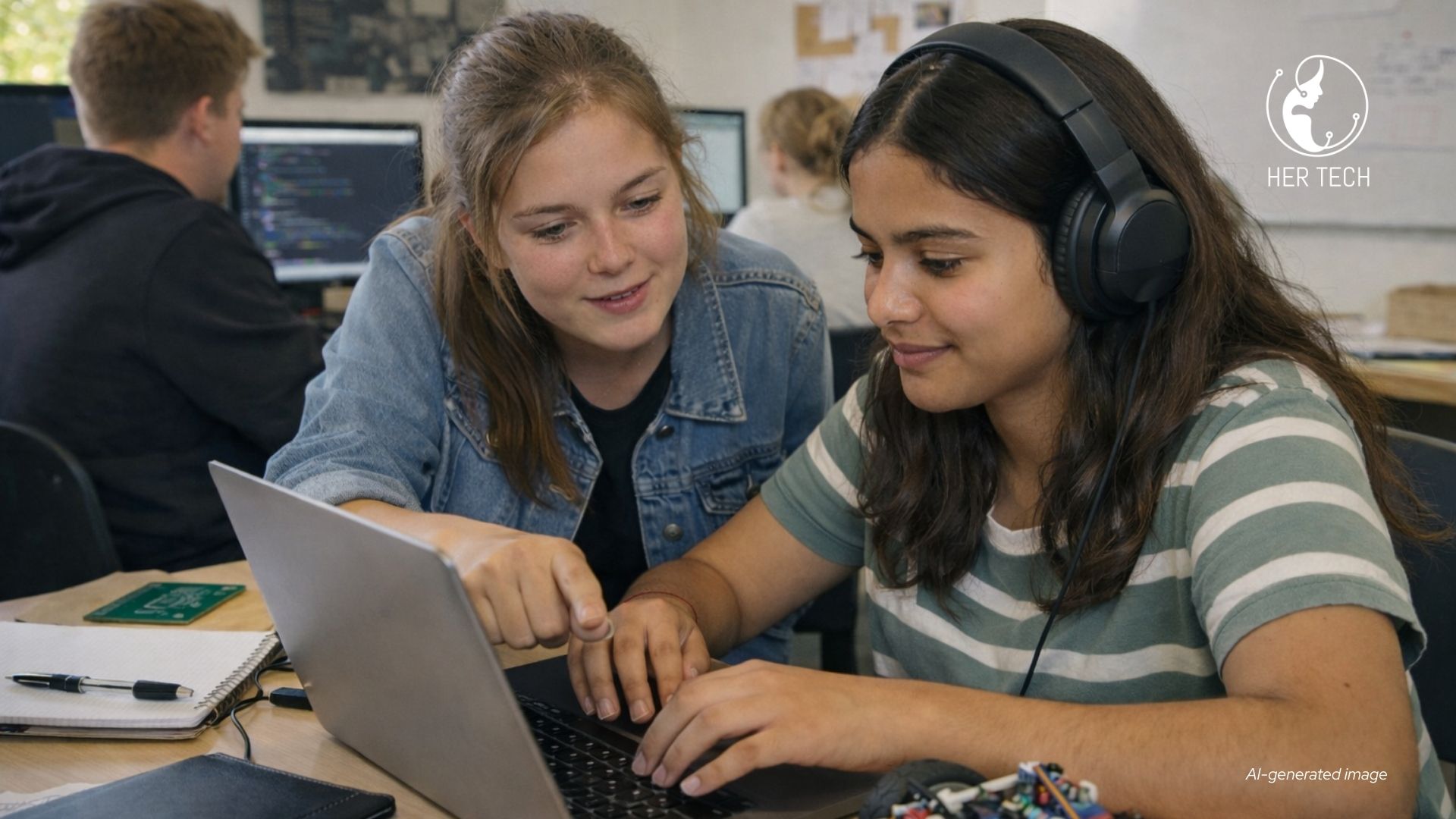
Role models are necessary, but they are not enough. For years, the mantra “if she can see it, she can be it” has led to a surge in mentoring programs and the promotion of female role models. However, as recent data suggests, visibility is merely the starting line, not the finish line, and mentoring alone may not be as effective as we may think.
While media (like those books and podcasts we’ve recommended previously) are crucial for raising awareness, there’s clear evidence that mentoring and role models are insufficient if they aren’t backed by structured pedagogical design and a shift in daily classroom practices. Findings from the Her Tech research highlight that mentoring initiatives, when implemented in isolation, struggle to produce long-term structural change.
Why Seeing a Woman in Tech Isn’t Enough
The simple presence of a mentor cannot compensate for structural flaws in how technical subjects are taught. Research highlights several reasons why the traditional “role model” approach often falls short:
- The Primacy of Learning Design: An analysis of “Creative Coding” workshops in Sweden revealed a 50% dropout rate, despite being focused on attracting girls. The failure wasn’t caused by a lack of role models, but by a pedagogical fault: the pace of learning was too fast and caused a high cognitive load (trying to learn coding and musical instruments simultaneously), overwhelming the students. Mentoring fails if students aren’t given the time and structure to actually consolidate their skills.
- The Confidence-Career Gap: Programs like Coding Girls in Italy have successfully boosted girls’ confidence in their programming abilities. However, interestingly, this boost in confidence hasn’t always translated into making the choice of STEM degrees at an equal rate to boys. This suggests that mentorship cannot fix long-term career choices unless we also dismantle the systemic stereotypes and pre-established cultural “software” that steer girls toward safer or already beaten paths.
- The School Climate: When the issue is systemic, it’s not easily fixed. Spending a few hours with a mentor cannot undo the “climate of exclusion” created by male-dominated group dynamics, as well as the subtle or subliminal messages that suggest computer science is inherently “not for girls.”
The Fix: What Traditional Mentorship Doesn’t Address
To be truly effective, mentoring must be integrated into a broader, more intentional approach. Here are the four pillars of an effective strategy:
1. Recognition and Legitimacy
It’s not enough for a girl to see a woman in tech, if she can’t see herself as an expert as well. Girls need to be recognized as technical experts themselves. One way to achieve this is to ensure that, in group settings, educators actively ensure that girls are not relegated to communicative or organizational roles, and have their technical contributions validated.
2. Psychological Safety and Peer Communities
Mentoring is at its most powerful when the community around it is supportive. Girls need an environment which fosters the idea that it’s safe to fail, and the pressure of being a perfectionist (a common cultural stereotype) is replaced by the freedom to experiment and make mistakes without judgment.
3. Mandated Role Rotation
In technical training, one of the most effective tools is compulsory role rotation: by circling through tasks (such as programming, documentation, hardware assembly) girls are guaranteed the opportunity to practice high-level technical skills, building confidence through practice rather than observation.
4. Connection to Social Impact
Mentorship is more effective when it connects ICT to real-world problems. Girls are statistically more motivated by technology when it is framed as a tool for social utility, having impacts on health, the environment, or community well-being, rather than just being a tool for technical competition.
The reflections shared here are grounded in the Her Tech Literature Review, a cross-country analysis of engagement strategies and gender dynamics in ICT education. The full report explores what works, what does not, and why, across primary schools, secondary education, VET and universities, offering evidence-based guidance for more inclusive and equitable teaching practices.
Read and download the full report to dive deeper into the research behind these insights