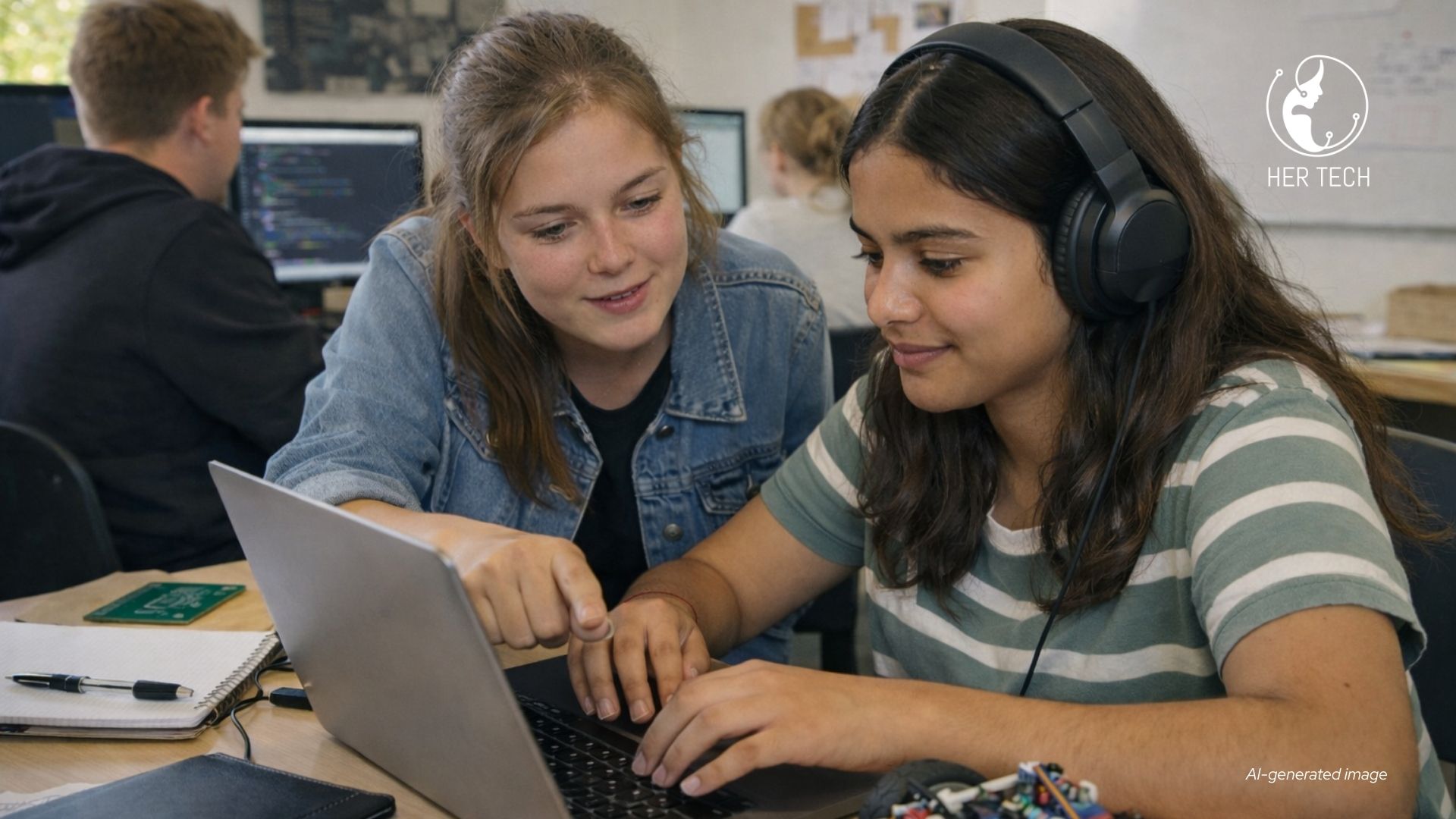
Across Europe, increasing girls’ participation in information and communication technology (ICT) is a strategic priority. The European Commission has repeatedly highlighted that women represent less than 20% of ICT specialists across the EU, despite strong overall female participation in education. While policy ambition is high, the transition from school to digital careers remains uneven, and adolescence is a critical turning point.
Ireland reflects many of these European trends, yet its school system presents distinctive structural characteristics that shape girls’ experiences differently from several other EU countries. In countries such as Estonia and Finland, computational thinking and digital skills are embedded in compulsory curricula from primary level. This early exposure reduces the perception of computing as a specialist or “high-risk” subject later in secondary school. Similarly, Sweden integrates gender-sensitive pedagogy into teacher education, aiming to address bias at classroom level.
Ireland has demonstrated strong policy commitment to digital education, but Computer Science at senior cycle remains optional and is not available in all post-primary schools. As a result, girls’ access to computing subjects depends heavily on school resources, teacher availability, and local leadership.
Participation in Leaving Certificate Computer Science typically remains between 15–20% female, broadly aligned with European averages. However, Ireland’s high proportion of single-sex secondary schools creates a distinctive dynamic. In some cases, applied technology subjects may be less visible or less prioritised in girls’ schools, affecting early exposure and confidence-building opportunities. Furthermore, Ireland’s exam-driven senior cycle structure can influence subject choice. Students may perceive newer subjects such as Computer Science as risky within a points-based system, particularly if they lack prior exposure.
Despite these structural challenges, Ireland benefits from a vibrant ecosystem of initiatives designed to support girls in ICT including:
- CoderDojo offers informal coding clubs nationwide, frequently hosting girls-only sessions to build confidence in supportive peer environments.
- Technovation Girls Ireland engages teenage girls in developing technology solutions to real-world problems, combining coding with entrepreneurship.
- Women in Technology & Science Ireland (WITS) provides structured mentoring programmes linking students with women working in tech.
- Smart Futures coordinates STEM ambassadors who visit schools across the country.
These initiatives reflect European best practice: hands-on learning, visible female role models, and sustained engagement rather than one-off workshops. However, unlike in some Nordic systems where computing is universally embedded, Irish participation still depends significantly on geography, school type, and access to external programmes.
Across Europe and Ireland alike, several evidence-based principles are emerging:
- Early and repeated exposure to digital skills
- Teacher training and confidence-building
- Visible and relatable female role models
- Framing ICT as creative, collaborative, and socially meaningful
- Structural access embedded within curriculum frameworks
Ireland’s innovative schools are aligning with these principles, but scaling remains the key challenge. Within the broader European landscape, Ireland sits at an important crossroads. It mirrors EU-wide gender gaps in ICT participation, yet it also demonstrates strong grassroots innovation and community engagement.