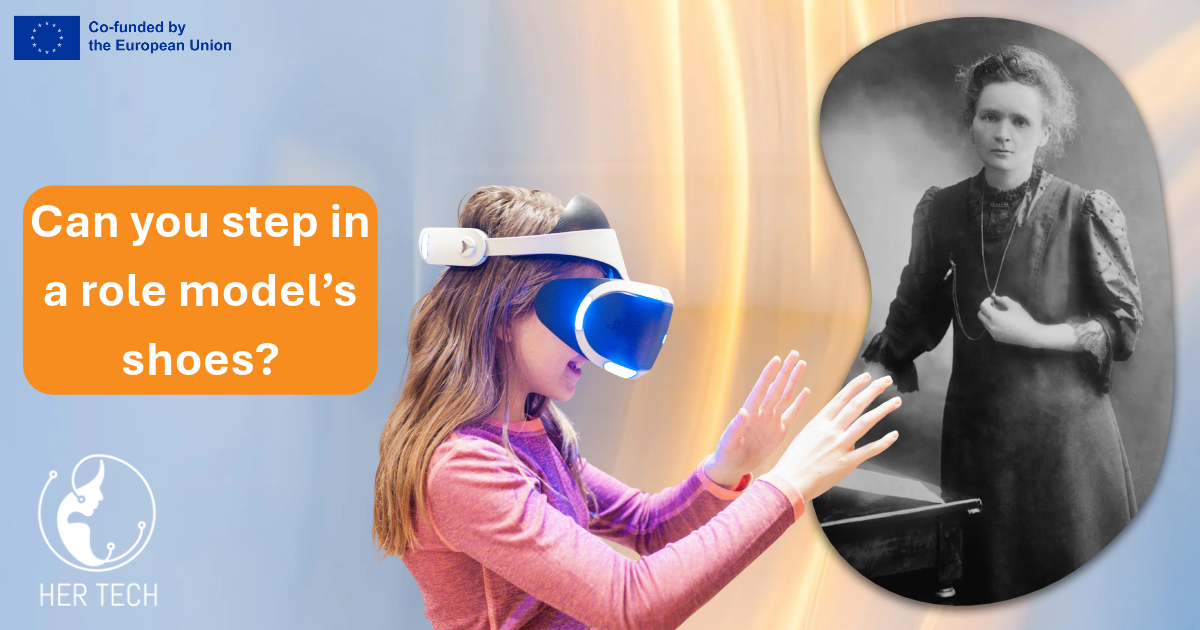
We often talk about the importance of female role models in STEM. But what if girls and women could do more than see them? What if, for a moment, they could actually experience being one of them?
A new study published in Computers in Human Behavior explored exactly this idea. 253 participants entered virtual reality and embodied Marie Curie, Albert Einstein or a gender-matched control avatar. Researchers measured their implicit gender–science associations one week before the experience, immediately afterwards and again one week later.
The result? Participants who embodied Marie Curie showed reduced implicit gender–science bias. The effect was still present a week later and was driven primarily by women. Embodying Einstein did not produce the same change. Interestingly, the control condition also reduced bias among men, suggesting that the effects of virtual embodiment depend on who is experiencing it and whom they embody.
For HER TECH, the study opens up an intriguing new perspective on role models. Visibility matters, but immersive technologies may offer something different: an opportunity to move from observing a counter-stereotypical role model to experiencing that identity from a first-person perspective.
One experiment cannot tell us whether such an experience will influence future educational or career choices. But it raises a fascinating question about how technology itself could be used to challenge stereotypes about who belongs in science and technology.
We often say: “You can’t be what you can’t see.”
Perhaps the next question is: what happens when you can step into her shoes?