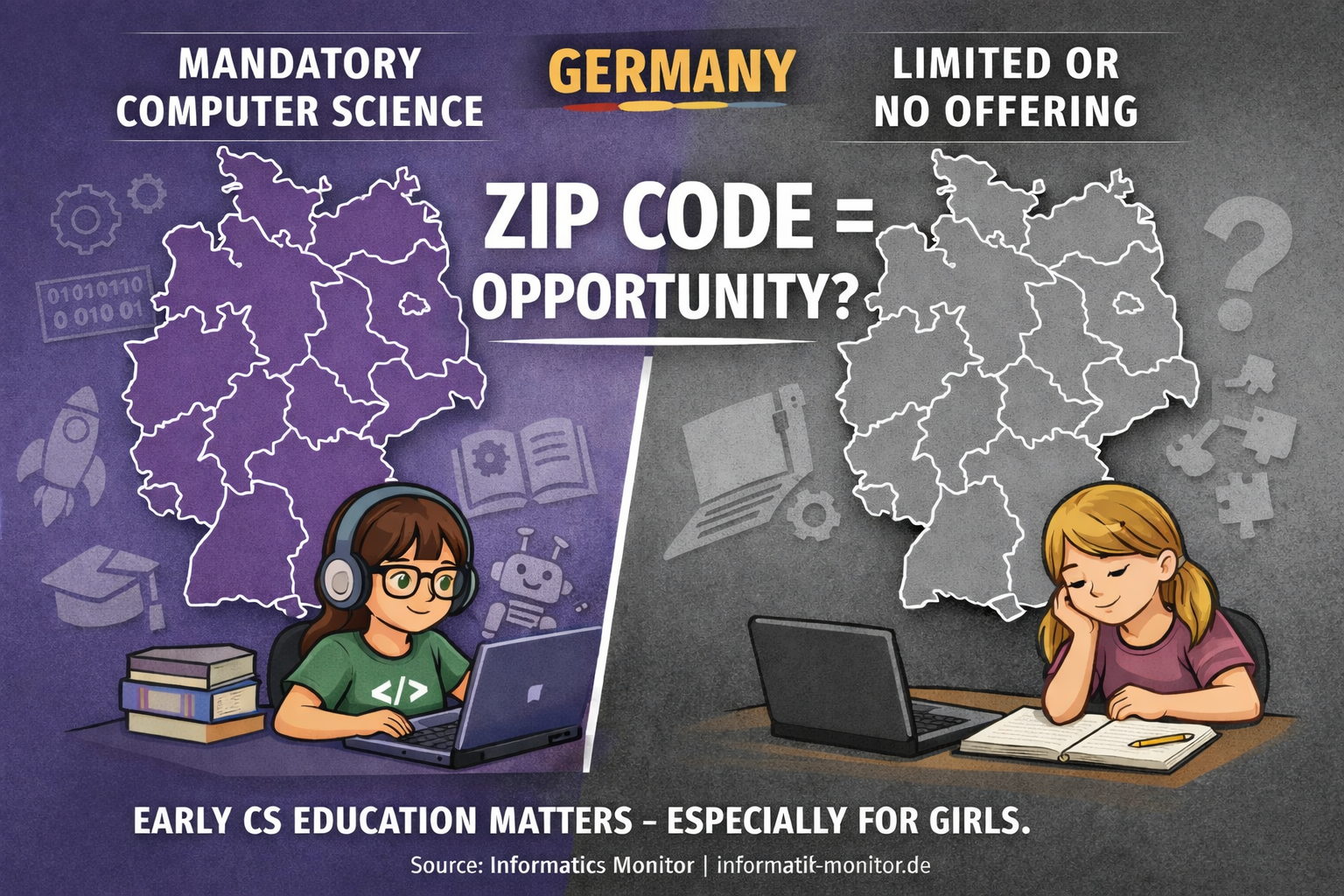
Experts agree that basic digital and computational competencies are no longer “nice to have” — they are essential for future participation in education, society and the labour market. Yet in Germany, access to Computer Science (CS) education still varies dramatically depending on the federal state. For girls in particular, this inconsistency shapes who ultimately finds their way into tech.
Across scientific, educational and industry stakeholders, there is now broad agreement: Germany needs mandatory Computer Science education for all students. The German Standing Scientific Committee (Ständige Wissenschaftliche Kommission), which advises the Conference of Ministers of Education, recommends introducing six annual weekly hours of compulsory CS in lower secondary education. The goal is to ensure that every student acquires digital and computational literacy early on.
Reality Check: Patchwork Education by Federal State
To understand why access to CS education in Germany is so uneven, it’s important to understand how the country organizes schooling. Unlike many European countries, Germany does not have a centralized national education system. Instead, education policy and curriculum decisions are made independently by each of the 16 federal states (Bundesländer). This means that compulsory subjects, learning objectives, teacher training pathways and school types can vary substantially from region to region — even though all students ultimately take the same final exams and enter the same national labour market.
In practice, this decentralized structure produces a highly inconsistent landscape for CS education. While some states have introduced compulsory CS in lower secondary education, others only offer it as an elective, as an after-school program, or not at all. As a result, German students’ exposure to digital skills often depends on something wildly unrelated to their talents or interests: their ZIP code.
A look at Bavaria illustrates this disparity. Bavaria is among the states that have integrated CS into lower secondary education, and the subject is compulsory across most general secondary school types. However, instructional time and continuity vary: only around two-thirds of students actually participate in mandatory CS, and opportunities diminish significantly in upper secondary levels. Other federal states lag further behind — offering CS only as an elective or as voluntary enrichment. For many students, especially girls, this creates uneven entry points into digital learning long before career decisions are made.
The Informatics Monitor: A New Evidence Base
To track this fragmented landscape, the Informatics Monitor (https://informatik-monitor.de/) provides the first comprehensive data-based overview of the state of CS education across Germany. It consolidates:
- the number of students taking CS
- whether and from when CS is mandatory
- hours of instruction per year
- availability of CS in the upper secondary level
- teacher training capacity
- current teacher shortages and recruitment needs
The data also confirms that even in states with mandatory CS, many schools fall short of the recommended instructional volume. Meanwhile, the teacher pipeline remains one of the biggest bottlenecks, with far too few CS teaching degrees completed to meet demand.
Why This Matters for Girls and Tech Talent Pipelines
Research from the Informatics Monitor and international studies point to a key insight: whenever girls encounter CS early, repeatedly and as a normal part of general education, their participation in advanced courses and digital study programs increases significantly.
Where these offerings are missing or voluntary, participation drops — and particularly among girls. The result is a systemic filter that starts long before university applications or job fairs.
For future tech talent pipelines, this is critical. Germany already faces significant digital skills shortages, and the tech sector remains overwhelmingly male-dominated. Without structural change in schools, the recruitment pool of women entering tech careers will remain artificially small.
Why This Topic Is Essential for HER TECH
For HER TECH, the state of CS education is more than a policy question — it is a matter of access, empowerment and digital participation. If girls are not supported early, they are less likely to:
- explore digital interests
- see themselves represented in tech environments
- choose STEM-related study paths
- enter digital professions later on
Creating a fair, modern and gender-inclusive digital society requires structural groundwork in schools. The Informatics Monitor offers a crucial evidence base to identify barriers, advocate for more equitable access and push for political and educational reforms.
Explore the Informatics Monitor: https://informatik-monitor.de/