All Digital promotes methodologies & certifications, facilitates partnerships among members & stakeholders, organises events and awareness raising campaigns, implements projects and surveys. The association also contributes to EU policy in the fields of skills, employment, social and economic inclusion, social innovation, Digital Single Market by policy papers and targeted communication.
1. Hello Katsiaryna and Dea. Thank you for the opportunity to meet you and discuss HER TECH project. Let us begin with a brief introduction. To begin, could you briefly introduce All Digital and your role within the institution?
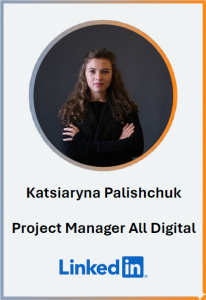
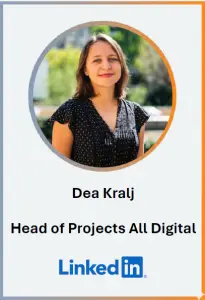
Hello! Katsiaryna is a project manager at All Digital, she joined the organisation 1,5 years ago, with a background in international development and law, with an experience in delivering EU-funded projects in educational field. While Dea is the Head of Projects, being at the organisation for 3,5 years, with experience in managing EU-funded and industry-supported projects, Dea oversees the project team and ensures the timely development of project deliverables. She has been working with Erasmus+ and EU-funded projects since 2020, specialising in digital inclusion, education, and skills.
2. What motivated your organisation to join the HER TECH project?
We joined the HER TECH project because it strongly aligns with our mission to promote inclusive digital transformation and ensure that everyone can benefit from digital opportunities. For All Digital, the project fits naturally within our broader work on digital skills, inclusion, lifelong learning, and equitable access to emerging technologies. It also creates valuable opportunities to collaborate with European partners, exchange good practices, and contribute to more inclusive digital education and employment pathways across Europe.
We were particularly motivated by the project’s focus on empowering women and girls through digital skills, education, and confidence building in technology-related fields. Across Europe, there are still significant gender gaps in STEM, AI, and digital careers, and we believe civil society organisations, educators, and digital competence centres have an important role in addressing these inequalities.
3. We are now approaching the end of the first year of HER TECH. How would you describe the project so far from your perspective?
From our perspective, HER TECH has been a very insightful project so far. It has allowed us to gather direct feedback from women working in the ICT sector, highlight their stories, and ensure their voices are reflected in the project’s work and policy recommendations.
It has also been particularly interesting to see how approaches, challenges, and support systems vary across the seven European partner countries, providing valuable comparative insights for building more inclusive ICT sector in Europe.
4. All Digital leads the work focused on understanding women’s motivation to pursue ICT studies and careers across different generations. Could you tell us more about your main activities?
We are the lead partner of Work Package 4, which has just started and is titled From Boomers to Alpha. The work package is designed to better understand what motivates women from different generations to pursue studies and careers in ICT.
The work package is structured around four interconnected activities:
- literature review exploring the motivational factors that influence women’s educational and career choices across generations. This helps us build a broader understanding of existing research and emerging trends.
- Building on this, we are developing targeted surveys aimed at women from different age groups and backgrounds to collect quantitative insights into their motivations for entering the ICT field. The goal is to identify both shared experiences and generation specific perspectives.
- We will also conduct in depth interviews with women from different generational cohorts to explore their personal journeys, challenges, and aspirations in greater detail. These conversations will help capture the human stories behind the data and provide a richer understanding of both common experiences and generational differences.
- Finally, we will bring together the survey and interview findings through a comparative analysis. This will allow us to identify key similarities and differences across generations, while also highlighting possible policy actions and educational approaches that could better respond to the needs of women in ICT. The findings will contribute to a comprehensive report that will support future work packages and policy recommendations.
5. Why is it important to look at women’s motivation to pursue ICT from a generational perspective?
Women from different generations have grown up in very different social, educational, and technological contexts. The opportunities, stereotypes, access to technology, and role models available to a woman from the Baby Boomer generation are very different from those experienced by Gen Z or Gen Alpha. Looking at motivation through a generational lens helps us better understand how these experiences shape career choices, confidence, and participation in ICT. It also allows us to design more targeted educational approaches, policies, and support systems that respond to the real needs and expectations of each generation.
6. As this part of the project is just starting, what are you most curious or excited to explore through this research?
I am particularly interested in hearing personal stories directly from women across generations and understanding what encouraged or discouraged them from entering ICT fields. It will be fascinating to identify both the differences and the common patterns across countries and age groups. I am also curious to explore how factors such as visibility of role models, digital confidence, family expectations, education systems, and workplace culture influence women’s choices today.
7. HER TECH brings together partners from several European countries and different sectors. How has the collaboration been so far?
The collaboration has been very positive and inspiring so far. One of the strengths of HER TECH is the diversity of perspectives within the consortium. Partners come from different sectors and national contexts, which creates very rich discussions and allows us to compare how challenges and opportunities for women in ICT vary across Europe. There is also a strong shared commitment among partners to create meaningful and practical outcomes that can support both policy and practice.
8. Why do you think it is especially important to better understand women’s career motivations in ICT today?
ICT is shaping almost every aspect of society, from education and healthcare to democracy and the labour market. If women are underrepresented in these fields, there is a risk that innovation and technological development will not fully reflect the needs and perspectives of society as a whole. At the same time, Europe faces growing digital skills gaps. Better understanding what motivates women to pursue ICT careers can help create more inclusive pathways into the sector and contribute to a more diverse, ethical, and innovative digital future.
9. What are you most looking forward to in the next phase of the project?
I am looking forward to the research activities themselves, especially the interviews and exchanges with women from different generations and backgrounds. I am also excited to see how the findings will translate into concrete recommendations and practical actions. One of the most valuable aspects will be identifying solutions that can genuinely support women at different stages of their educational and professional journeys.
10. What would you say to organisations that want to encourage more women to pursue careers in ICT?
It is important to move beyond general statements and create environments where women genuinely feel represented, supported, and encouraged. This starts with visibility of diverse role models, inclusive learning opportunities, mentorship, and workplace cultures that value different perspectives. Organisations should also listen carefully to women’s experiences and involve them directly in shaping initiatives and strategies. Encouraging women in ICT is not only about equality, but also about building stronger, more creative, and more inclusive digital societies.
 |
 |