Sineglossa is a Center for Cultural Research and Production that fosters sustainable development models in response to global challenges through the processes of contemporary art. We believe in the essential social role of culture and are committed to culture-based innovation, experimenting and sharing new tools to redefine the values that guide our choices and imagine, together, more humane futures. Sineglossa operates in a constitutively European dimension as official partner of the New European Bauhaus, launched by the European Commission in 2021 to realize the European Green Deal.
1. Hello Alessia and Alessandra. Thank you for the opportunity to meet you and discuss HER TECH project. Let us begin with a brief introduction. To begin, could you briefly introduce your organisation and your role in the HER TECH project?
Alessia: Hello Aneta, I am Alessia Tripaldi, director of Research and Training in Sineglossa, a Center for Cultural Research and Production based in Italy which applies contemporary art processes to the challenges of our time.
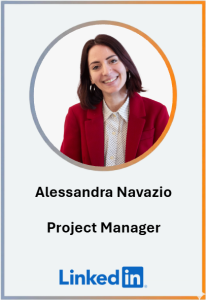
Alessandra: And I am Alessandra Navazio, project manager for Sineglossa and representative for HER TECH within the organisation.
In the HER TECH project we actively contribute to all the outputs produced by the various partners, and as Sineglossa we are specifically responsible for Work Package 5, which focuses on the development of online learning content and teaching materials – essentially the project’s training package, which will take shape as an online platform with methodologies and teaching tools.
Alessia: It’s worth adding that our involvement has roots in existing collaborations: we had already worked with some of the HER TECH partners, including Algebra University, on NuGamers, a related project focused on women and gaming for which we developed the final toolkit. They were already familiar with the methodologies we develop, and also in this project they chose to assign us a similar output.
2. What motivated your organisation to join the HER TECH project?
Alessia: For several years now, among the various educational topics we work on, Sineglossa has focused on the STEM field – with an artistic and creative approach that intersects scientific disciplines, and with a specific focus on women. We know that women face more obstacles in building careers in this area, and that statistically they enter these fields less, partly due to a whole range of cultural biases. HER TECH therefore built on what we had done so far, while broadening the scope: it was no longer just about a creative or gaming-based approach, but specifically about bringing women and STEM disciplines together. Being a larger project than the recent ones we had worked on in this area (WeSTEAM, Nugamers e STEAM Process), it gives us the opportunity above all to work even more at a transnational level – and what’s exciting about these projects is that they bring together methodologies, perspectives and good practices from different countries, which broadens our horizons and opens up new opportunities.
Alessandra: For instance, when I attended the in-person meeting in Helsinki last March, I saw how meeting face to face, sharing challenges and working in groups with partners from different countries was a great opportunity to identify what we don’t yet know about women and ICT and how to explore it in the new WP.
3. We are now approaching the end of the first year of HER TECH. How would you describe the project so far from your perspective? And what have you found out you did not know or did not expect?
Alessandra: This first year has been interesting because we focused a lot on conducting research, interviews, and understanding the state of the art in Italy on women and ICT, across all age groups. What emerged is that research in this field exists but is very fragmented – you find a paper or a good practice in one region, or national programme guidelines, but often the next step is missing: understanding how those recommendations have actually been put into practice in smaller contexts, such as a school or a local council. Having a space to bring all of these elements together and compare notes with other countries has been very enriching.
It also emerged that perceptions are backed by real data: the survey conducted in Italy and across Europe gathered over 250–300 responses, confirming that cultural biases are concretely present in children as young as six.
In Italy, for example, we found that the gender gap doesn’t come from a lack of interest, but is a result of several barriers, such as internalized failure (boys are encouraged to take risks while girls internalize technical difficulties as a personal lack of ability), influencer gap (as girls aged 13–17 are strongly influenced by friends and social media, they lack influencer models in STEM careers) and passive school systems (Italian respondents feel the current educational system is not yet doing enough to actively de-stereotype ICT)[1].
Data and interviews show that there is still a great deal to be done at the implementation level, beyond what is already happening on the formal one.
There’s also a third element that surprised me: the people working in this field – among those I met, the manager of a coding camp association, a primary school teacher, someone in charge of gender equality plans at university – often don’t know about each other’s initiatives. This research could help open up a dialogue between the needs of different sectors.
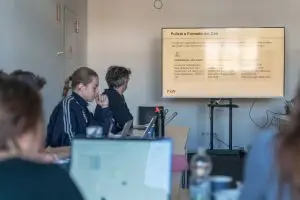
4. Sineglossa will lead the development of online learning content and teacher training materials. Could you tell us more about what this work package will focus on?
Alessia: Our work package focuses on three main areas. The first is the development of gender-sensitive online learning modules, designed specifically to engage girls in ICT, incorporating findings from previous research phases and connecting technological concepts to real-world and social contexts. The second is the creation of teacher training materials, with guidelines on how to build an inclusive classroom environment, address gender biases, and implement engagement strategies identified in earlier phases of the project. The third is the development of a support platform for educators – an online space to access the modules, training materials and additional resources, and to share experiences and best practices.
5. From your perspective, what makes ICT learning content engaging and appealing, especially for girls?
Alessia: The fact that the content is relational – meaning it encourages collaborative activities, ideally non-hierarchical ones, so genuinely cooperative and peer-based in every sense. And the fact that it also includes a creative and humanistic component, making room for the more creative side rather than focusing solely on the purely technical. In that sense, it’s no coincidence that gaming is one of the ICT industries that seems to generate the most interest among girls, precisely because of that creative and artistic dimension.
Alessandra: This comes through clearly in the interviews conducted for the project as well. Girls are more engaged when the field of computing isn’t an end in itself, but can be applied to concrete problems – in biomedical engineering, in medicine, or to address an environmental or social challenge. When it’s framed that way, interest grows. One interesting example I came across in Helsinki: a teacher running a game design course – which weaves together storytelling and artistic elements alongside programming – said that far more girls sign up for her course than for pure programming courses.
6. What are you most excited to start working on as this phase of the project begins?
Alessia: Our work package is about to kick off, so we’ll be getting into the heart of what Sineglossa does. We’re very curious to see how different generations of women approach the world of computing and technology (from Boomers to Alpha) and what peering looks like across generations. It’s one of the research threads we expect will be the most full of surprises.
7. HER TECH brings together partners from several European countries and different sectors. How has the collaboration been so far?
Alessandra: It’s a very productive collaboration. One thing that sets it apart from other projects is that in every work package there is a genuine contribution from all the partners – it’s not a case of one partner preparing a work package while the others just review it. This makes the results we’re gathering truly interesting.
The in-person meeting in Helsinki was particularly valuable: it gave us the chance to meet face to face, confront on where we stood with the our work packages, and understand – in the steering committee – whether the quality of what we’re doing is satisfactory for everyone. It was also interesting to see how different partners tackled the same challenges in different ways, for instance in the process of identifying people to interview.
Alessia: And then transnational collaboration helps us grow as an organisation – new countries, new good practices, new ways of thinking about education. It broadens our horizons and opens up new opportunities.
9. Why is it important to rethink how digital learning materials are designed today?
Alessia: Because also digital materials are at risk in reproducing biased narratives around gender difference. If digital products (including teaching materials) become cold, solitary products, that tends to be reflected in the kind of teaching they enable. A young woman approaching these areas of study might find herself in front of a course that follows a “text, test, quiz, move to the next section” format, when in fact online materials can also be designed to be interactive and to spark creativity. Being digital doesn’t necessarily mean being cold compared to in-person learning.
It would also be interesting to involve students in the design and testing phase of these materials, to understand how to improve them even at the level of language – because those who produce them today often come from a non-digital world.
9. What would you say to teachers who want to make their digital lessons more inclusive and creative?
Alessandra: Three things, above all.
The first is that while it’s right to encourage access to STEM, inclusion doesn’t mean pushing everyone in the same direction or suggesting that one path is “better” than another. Offer examples, tools and activities that cut across different disciplines and show non-stereotyped role models – encouraging girls towards computing just as much as encouraging boys towards care and relational dimensions. The movement towards inclusive education (and equality) doesn’t necessarily head towards the centre; it also goes towards the margins, making all choices and all paths visible and legitimate, as I had the chance to reflect upon and discuss with a gender equality manager and researcher of the University of Turin.
Alessia: The second suggestion is to listen to and involve students in the design phase of lessons. We must always pay attention to all the materials we produce, because even a five-line text can fail to be inclusive. The tools we use have been shaped over years and years of biased contexts, and whenever applied it’s always worth asking ourselves how much they risk carrying those biases.
The third piece of advice we would give is to seek out more opportunities for dialogue and discussion on these topics from compulsory school age onward. If a girl has always felt sidelined during math lessons, it’s unlikely she’ll go on to study physics at university. And if she does, the data tells us that dropout rates among women are much higher than among men in certain degree programmes – at least in Italy – often because they feel isolated. We believe that opening up a dialogue, a space for discussion on these topics from the very early years of education, can make a positive contribution to greater awareness among girls, not just in themselves, but also of the social dynamics within which they will build their working lives – showing them that, despite the difficulties, there are people working towards change in exactly this direction.
 |
 |
[1] https://her-tech.eu/girls-tech-education-italys-school-programmes/