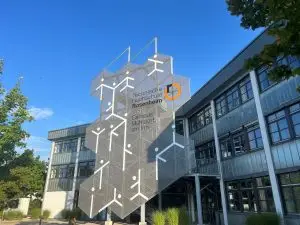
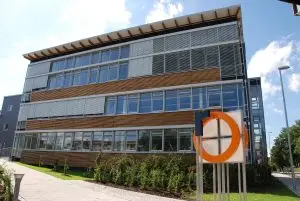
Rosenheim University of Applied Sciences is a regionally rooted institution with an international reputation located in southern Germany. Across four campuses, it offers over 50 practice-oriented bachelor’s and master’s degree programs in the fields of engineering, business, design, health, and social sciences. Rosenheim University of Applied Sciences currently has approximately 7,600 students (as of the 2025/26 winter semester).
1. Hello Nicole, Laura and Martina. Thank you for the opportunity to meet you and discuss HER TECH project. Let us begin with a brief introduction. To begin, could you briefly introduce your organisation and your role in the HER TECH project?
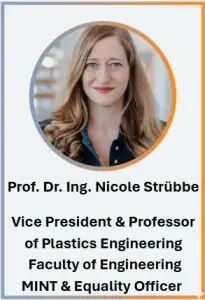
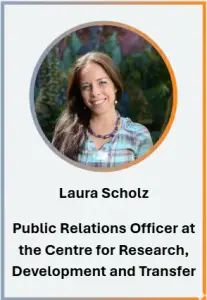
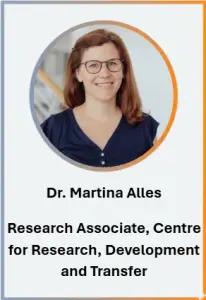
Nicole Strübbe is a professor of plastics engineering and vice president of Rosenheim University of Applied Sciences, STEM Coordinator, initiator of the Children’s University, and founder of the regional network MINTnetz18+, which connects stakeholders from education, business, and society to promote young STEM talent; she also leads the HER TECH project in Germany. Laura Scholz and Martina Alles are senior researchers in the HER TECH project. Laura since May 2025 and Martina since January 2026. They are responsible for the scientific oversight of the project, the collection and analysis of data, and the development of policy recommendations for promoting girls and women in ICT professions. In addition, they coordinate research activities with international partners and prepare reports and publications.
2. What motivated your organisation to join the HER TECH project?
Rosenheim University of Applied Sciences is participating in the HER TECH project because it has been actively promoting equality in STEM subjects for many years and aims to establish STEM as a natural part of children’s education from an early age. Building on this long-standing commitment, the university has already been actively involved in STEM education in a variety of ways prior to the project’s launch: These include, among other things, the Children’s University, which sparks an early interest in scientific and technical topics, as well as the collaboration with the ‘Kinder forschen’ Foundation, through which early years education professionals are trained in STEM topics. In addition, the university strengthens the link between education, science and industry through regional networks and practice-oriented projects.
Through the HER TECH project, the university aims to contribute its experience in STEM education, networking and gender equality initiatives to empower girls and women in the long term. Together with European partners, the project will investigate the causes of the gender gap in information and communication technology and work to break down existing barriers. The aim is to develop practical concepts that make it easier for young people to access technical professions and contribute to greater equality of opportunity in the STEM sector in the long term.
3. We are now approaching the end of the first year of HER TECH. How would you describe the project so far from your perspective?
From our perspective, the first year of the HER TECH project was very successful and insightful.
In WP2, we analyzed national initiatives in Germany aimed at inspiring girls to engage with STEM/ICT. Across these initiatives, key success factors include low-threshold, gender-sensitive information offerings, long-term mentoring, playful and hands-on learning approaches, and targeted support programs for high-achieving female students. These approaches foster early interest, self-confidence, and the visibility of role models. At the same time, structural challenges remain, such as insecure funding, a lack of follow-up opportunities after program completion, limited regional reach, and the high selectivity of some programs. Overall, the initiatives provide important impulses for early STEM motivation, but they differ significantly in their long-term impact and continuity.
In WP3, we are currently investigating which teaching strategies and methods in computer science education are particularly effective in actively engaging female students. Initial findings point to gender-specific differences in interest and participation in STEM fields. Interviews repeatedly indicate that girls are less likely to participate, especially in optional ICT courses, while no differences in performance are observed when participation levels are comparable. Possible reasons mentioned include lower self-confidence, gender-specific socialization, and existing stereotypes. To support girls, female role models, practice-oriented teaching approaches, and the integration of computer science with creative and design-oriented tasks are highlighted as particularly effective.
A particularly valuable aspect of the past year was the intensive exchange and comparison with our international project partners, which opened up new perspectives and supported the development of practical measures to make ICT more accessible and appealing to young women.

4. TH Rosenheim will lead the development of policy recommendations and the new teaching framework. Could you tell us more about what this work package will focus on?
Rosenheim University of Applied Sciences leads the development of policy recommendations and the new teaching framework within the HER TECH project. First, the results of the previous work packages are analysed to derive key insights into gender-specific engagement and motivational factors in ICT education. Based on this, evidence-based policy recommendations are developed for educational institutions and decision-makers, along with a flexible teaching framework that includes practical strategies and methods for different school levels. Finally, the framework and recommendations are validated and refined through workshops with educators and stakeholders to ensure their applicability and effectiveness.
5. Why is it important to translate research and project results into policy recommendations?
It is important to translate research findings and project results into policy recommendations because this is how they gain direct influence on education systems and decision-making processes. Only by linking evidence and practice can we ensure that proven strategies for promoting girls and women in ICT are implemented sustainably. Policy recommendations make it possible to systematically reduce barriers, support schools, teachers, and institutions, and improve gender balance in STEM degree programs and careers in the long term.
The interviews also made it clear that the policy framework can ideally complement and meaningfully enhance initiatives from extracurricular activities and the home environment by better connecting existing measures and ensuring their long-term impact.
6. What are you most looking forward to exploring as this phase of the project approaches?
In this phase of the HER TECH project, we are particularly looking forward to translating the insights gained into concrete recommendations for action and a practice-oriented teaching framework. We are eager to see how the validation workshops with educators, policymakers, and other stakeholders will provide new perspectives and valuable feedback.
We are also especially interested in how the developed strategies and methods can be implemented in different educational contexts and what impact they will have on girls’ engagement in ICT subjects. Overall, we look forward to transforming the research findings into practical measures that will support gender balance in STEM fields in the long term.
7. HER TECH brings together partners from several European countries and different sectors.
How has the collaboration been so far?
Collaboration within the HER TECH project with partners from various European countries has been very enriching so far. The exchange with partners, the close cooperation, and especially the in-person meetings have been particularly valuable, extending beyond the actual project work. They provide opportunities to jointly discuss, compare, and critically reflect on the results from WP2 and WP3.
Through this mix of international perspectives, we gain a deeper understanding of the factors influencing girls’ engagement in ICT subjects. Overall, the collaboration has strengthened the project’s interdisciplinary approach and laid the foundation for the future development of recommendations and teaching frameworks.
8. Why is it important to support gender balance in ICT from a policy perspective?
From a policy perspective, it is important to promote gender balance in ICT because a more equal representation of women and men strengthens innovation, creativity, and diversity in technical professions. Policy measures help to reduce systemic barriers and ensure equal opportunities for all. They support educational institutions and companies in attracting girls and women to ICT studies and careers in the long term. At the same time, increasing the participation of women in ICT helps to address the skills shortage and secure competitiveness in an increasingly digital world.
9. What are you most looking forward to in the next phase of the project?
In the next phase of the HER TECH project, we are particularly looking forward to exploring the motivational factors of women in ICT across different generations. To this end, we will conduct interviews to better understand personal experiences, career paths, and barriers.
What is especially exciting is the comparison between different age groups and educational backgrounds in order to identify patterns and influencing factors. The findings will provide an important basis for the further development of policy recommendations and the teaching framework.
10. What message would you like to share with policymakers and education stakeholders across Europe?
We aim to convey to policymakers and education experts across Europe how important it is to actively inspire girls and young women to engage with ICT subjects and to systematically reduce structural barriers. Early promotion of STEM skills and the visibility of role models are crucial so that girls perceive STEM studies and careers as a natural option.
Political support and practice-oriented initiatives at all levels of education help to improve gender balance in ICT in the long term. Only through joint efforts can we create an inclusive and diverse digital future.
|
|
 |
 |