South-Eastern Finland University of Applied Sciences is one of the largest universities of applied sciences in Finland. We are a multidisciplinary institution. Our fields of education include business, health, gaming, ICT, engineering, forestry, logistics, social sector and tourism. The number of students in our university of applied sciences is over 12,000, offering 50 bachelor’s degree programs and 30 master’s degree programs. Our 1000 experts work across four campuses: Kotka, Kouvola, Mikkeli, and Savonlinna in South-Eastern Finland. Our Research, Development, and Innovation (RDI) activities support the growth and development of our region. We conduct applied research in wellbeing, technology, digital economy and creative industries.
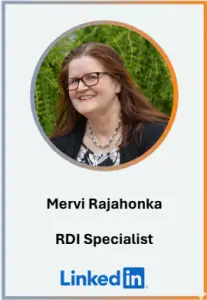
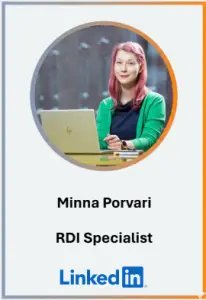
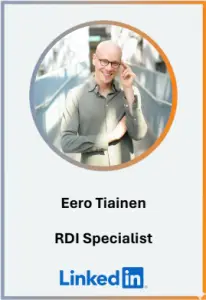
1. Hello Silja, Mervi, Eero and Minna. Thank you for the opportunity to meet you and discuss HER TECH project. Let us begin with a brief introduction. To begin, could you briefly introduce your organisation and your role in the HER TECH project?
In the HER TECH project Xamk leads WP2, review of existing research and a mapping of national initiatives to stimulate girls in pursuing ICT studies and professions in Europe. This work has been done together with all the partners. The most important deliverable of WP is “What does and does not work – Compendium of the best practices in different European countries”, published in spring 2026.
2. What motivated your organisation to join the HER TECH project?
International cooperation is an important part of our profile, with more than 350 partner educational institutions around the globe. Xamk is Finland’s largest UAS in the field of RDI, based on external financing alone. There are over 250 ongoing projects annually. The lower participation of women in ICT studies and professions is a pertinent challenge – in Finland, too. We have worked with the ICT and equality issues in our previous projects, such as the Girls just wanna have FUNdamental IT skills project.
3. We are now approaching the end of the first year of HER TECH. How would you describe the project so far from your perspective?
Eero was the person mainly responsible for the WP2 research phase. He tells that the project has helped him to understand how strongly segregated our societies still are, and how deeply ingrained many of the underlying reasons are. For him personally, HER TECH has been an amazing opportunity to learn about gender-balance issues. The project has challenged him to see the world and these issues from a female perspective. It has also widened his perspective to a more European level.
4. XAMK leads the work package focused on reviewing existing research and mapping national initiatives that support girls in pursuing ICT studies and careers. Could you tell us more about your main activities and progress so far?
We have clustered the main target groups, created methodology and process for data collection, conducted research in Finland and Estonia about the existing programs and distilled the enablers and barriers for women in ICT. For the Transnational Research Report, we gathered the insights across ten nations and created cross-cultural analysis about enablers and barriers in them. Based on this, we finally composed a Handbook – or Compendium – of Best Practices that combines the key insights about existing initiatives and their more and less effective methods that have been used in the last ten years for engaging girls and women with ICT.
5. Based on your research, what early trends or patterns are emerging across countries?
Cultural factors and gendered stereotypes appear to be a key underlying cause. At the same time, the prevailing notion of technology needs to shift toward being more human-centred, meaningful, and approachable in order to become more inclusive of diverse groups. On average, women tend to base career decisions more strongly on soft values, and the ICT sector should be more responsive to these values as well. Such a shift is not only necessary for inclusion but also beneficial for society as a whole.
6. Was there anything that particularly surprised you during the research phase?
Eero points out that the strength of segregation is striking. Gender imbalance in the ICT sector has broader societal implications, as it affects women’s access to power and influence due to the sector’s central role in society. Mervi adds that the Finnish situation is worse than one might expect, considering the extensive equal opportunities provided by society. In childhood, interest in mathematics, science, and technology appears largely similar across genders. As children grow older, however, girls are often steered—through peer pressure or competing interests in the humanities and languages—toward making choices that lead them away from ICT careers. There is a structural problem within the education system, and secondary school represents a critical point of no return. However, there are hurdles also later in women’s career paths.
7. HER TECH brings together partners from several European countries and different sectors. How has the collaboration been so far?
The collaboration has been fruitful. Each partner contributes differently, reflecting both national contexts and the partner organization’s role within its respective system. Discussions have been eye-opening and multifaceted. Particular acknowledgement must be given to the lead partner, Algebra University, which has smoothly coordinated this complex project as a whole.
8. Why do you think projects like HER TECH are important today?
Equality is most commonly understood as the provision of equal opportunities. However, this approach appears insufficient to address persistent structural inequalities, such as gender segregation in the ICT professions. Merely “offering” girls the same choices is not enough, as there are often hidden structural, cultural, or institutional factors that limit their ability to take up these opportunities or lead them to disengage over time. While equality of opportunity focuses on conditions at the “starting line,” equality of outcomes seeks to equalize results at the finish line, which may require active redistributive or corrective measures. We need more approaches leading to equality of outcome.
9. What are you most looking forward to in the next phase of the project?
Across Europe, there are already proven practical solutions that are demonstrably effective. These solutions now need to be scaled up and integrated into the mainstream. Ultimately, achieving more human‑centred, meaningful, and approachable technology requires a more diverse ICT workforce.
10. What would you say to educators, policymakers or organisations who want to better support girls and women in ICT?
Girls’ and women’s disengagement from ICT is rarely the result of individual choice alone. Subtle discouragement, gendered norms, lack of role models, biased guidance, educational practices, and workplace cultures all matter. A key task for institutions is to identify and actively dismantle these hidden barriers rather than assuming a neutral playing field.
 |
 |
 |
 |