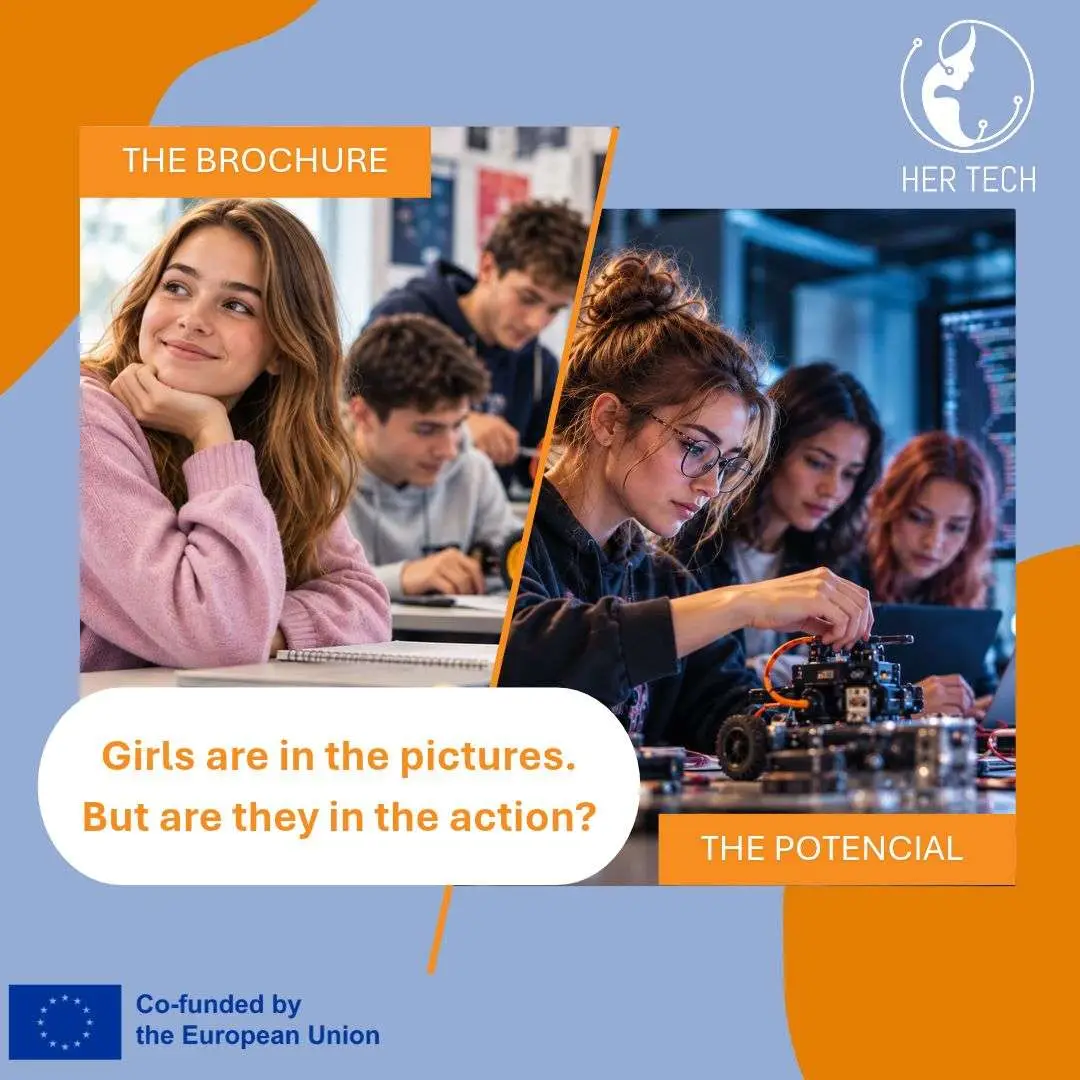
Gender segregation in technology education and the broader tech industry remains a persistent challenge. While policy initiatives frequently champion gender equality and inclusivity, a closer look at educational marketing alongside real-world industry experiences reveals a significant disconnect between official messaging and lived reality. Comparing a recent discourse analysis of upper-secondary school promotional materials with an in-depth interview with female software engineers illustrates how subtle gender messaging in education directly shapes their incorrect perspective on the career choices and workplace dynamics.
The Marketing Myth: What the Research Reveals
A discourse analysis of promotional images on upper-secondary school websites shows how educational marketing visually reinforces traditional gender divisions[1]. Although schools display a higher proportion of female students than actually enroll to project an image of inclusivity, girls are portrayed as passive observers and are heavily concentrated in subfields framed as “creative” rather than core technical domains. Furthermore, technical collaboration is depicted almost exclusively as a male-bonding activity, while STEM programs emphasize individual competence over social connection, , potentially discouraging people from pursuing opportunities in these fields.
Key patterns identified:
- Superficial Inclusion
- Passive vs. Active Roles
- The “Creative” Specialization Trap
- Male-Bonding and Missing Female Contexts
- Individual Competence over Social Connection
This portrayal reinforces existing stereotypes among schoolchildren that STEM students are “nerdy” and socially disconnected. It also places additional pressure on girls who choose these subjects, as they risk being perceived as passive, one-dimensional, less socially capable, and disconnected from their female peers.
The Lived Experience: How the Interview Mirrors the Research
The theoretical and visual findings of the research study are vividly reflected in the real-world trajectory described in the interview:
- Internalizing the “Geeky” Stereotype and Self-Exclusion
The research shows that technology is presented as an environment requiring specialized, individual competence rather than social connection. The practitioners recall having a strong stereotypical image of computer science students as a homogenous, “nerdy” group of men; a template they felt they could not identify with socially. Because schools provided little information on what tech careers actually involve, their decision-making was driven by social belonging and prejudice rather than an understanding of the work itself.
- Misaligned Role Models: Managers vs. Hands-On Programmers
While school marketing often portrays girls in passive or peripheral creative roles rather than engaging them in hands-on technical activities, the interviews reveal a similar pattern in professional role modeling. Practitioners observed that efforts to celebrate women in tech tend to focus almost exclusively on managers and executives, overlooking women actively involved in programming and technical work. They argue that this approach creates a misleading picture of career progression by highlighting leadership positions without showing the practical skills and experience required to reach them. Instead, they emphasize the importance of showcasing women in hands-on coding roles, demonstrating that technical expertise, developed through learning the fundamentals and gaining practical experience, forms the foundation for advancing into technical leadership.
- Practical Tech as a Tool of Empowerment
The research study notes that passive depictions of female students contribute to lower technical self-efficacy. However, the interviews demonstrate what happens when women get direct, practical access to coding, which could be a “massive tool of empowerment”. Knowing how to code provides personal independence, high career autonomy, and creative freedom; qualities rarely communicated in early educational guidance.
Bridging the Gap: Key Takeaways
The comparison between school promotional imagery and real-world career reflections demonstrates that superficial diversity in marketing is not enough. To foster true gender inclusion in technology:
- Show Active Female Engagement: School and industry communications must move away from depicting women as passive observers or limiting them to “creative” subfields, showing them actively building, circuit-testing, and programming.
- Promote Hands-On Female Collaborations: Visuals and educational environments must showcase female students collaborating together on technical tasks to build social belonging.
Reframe Tech as an Empowering Skill: Early education should present programming not as an intimidating, isolated pursuit for “tech geniuses,” but as a practical, versatile tool for creative independence and career flexibility.