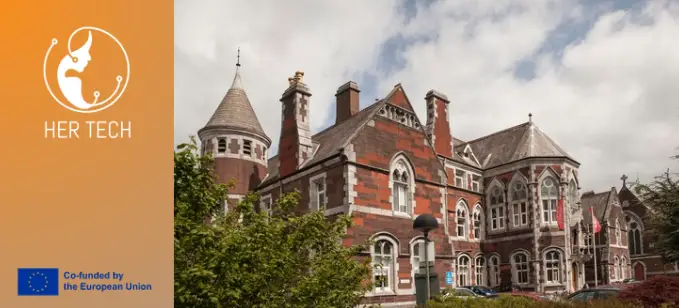
Griffith College is one of Ireland’s leading independent higher education institutions, with campuses in Dublin, Cork, and Limerick and a strong focus on innovation, applied learning, and international collaboration. Through the Griffith College Research Hub, the college actively participates in European research and education initiatives that address digital transformation, inclusion, sustainability, and future skills development. Griffith College has extensive experience collaborating with academic institutions, industry partners, NGOs, and policymakers on projects that aim to create meaningful social and educational impact across Europe.
1. Hello Laura and Aine Thank you for the opportunity to meet you and discuss HER TECH project. Let us begin with a brief introduction. To begin, could you briefly introduce your organisation and your role in the HER TECH project?
At Griffith College Dublin, we are deeply committed to innovation in education, applied research, and international collaboration. Through the Griffith College Research Hub, we work on a range of European projects focused on digital education, inclusion, employability, and social impact like HER TECH. At Griffith we believe in creating learning environments that are accessible, inclusive, and responsive to the changing needs of society and the labour market, so HER TECH aligns very closely with our broader mission to support equality in education and encourage more diverse participation in technology-related fields.
Within HER TECH, Griffith College will lead the piloting phase of the gender-inclusive ICT teaching framework the consortium is working on right now. Our role includes coordinating the preparation and implementation of pilots across partner countries, developing assessment tools and evaluation mechanisms, drafting pilot guidelines, and supporting stakeholder engagement activities. We are also responsible for helping ensure that the project outcomes are evidence-based, scalable, and transferable across different educational settings throughout Europe. This means working closely with schools, teachers, students, parents, and policymakers to gather meaningful feedback that can strengthen the long-term impact of the project.
2. What motivated your organisation to join the HER TECH project?
One of the main motivations for joining HER TECH was the ongoing underrepresentation of girls and women in ICT and STEM education pathways across Europe. Although awareness of the issue has increased significantly in recent years, there are still many structural, cultural, and educational barriers that discourage girls from engaging with technology-related subjects and careers. At Griffith College, we believe educational institutions have an important role to play in addressing these challenges by promoting inclusive teaching practices and creating supportive learning environments where all students feel represented and encouraged. We were also particularly interested in HER TECH because of its strong emphasis on evidence-based educational innovation. The project goes beyond simply creating learning materials, it focuses on testing, validating, and refining approaches through real-life pilot activities in schools across Europe. This is a practical and collaborative approach which is important to us because we believe meaningful change in education requires both research and direct engagement.
3. We are now approaching the end of the first year of HER TECH. How would you describe the project so far from your perspective?
The first year of the project has been extremely positive and productive from our perspective. Partners have worked collaboratively to build a strong foundation for the next phases of the project, including research activities, needs analysis, framework development, and planning for the pilots. There has been a very strong sense of shared purpose among the consortium, with all partners bringing valuable expertise and perspectives to the discussions and development process.
One of the key strengths of HER TECH so far has been the diversity of the partnership itself. Bringing together organisations from different European countries and sectors has created a rich environment for knowledge exchange and collaborative problem-solving. We have been able to explore how gender inclusion challenges differ across educational systems and cultural contexts while also identifying many common themes and opportunities for improvement. This international and interdisciplinary collaboration is helping to ensure that the teaching framework being developed is both practical and adaptable to different environments. Another important aspect has been the project’s strong focus on stakeholder, we’ve prioritised listening to educators, students, and other stakeholders from the beginning.
4. Griffith College will lead the piloting of the new learning content developed within the project. Could you tell us more about what this phase will involve?
The piloting phase represents one of the most important stages of the HER TECH project because it allows the newly developed teaching framework and learning materials to be tested in real educational environments. Griffith College will coordinate this process across seven European countries, working closely with schools, teachers, students, and project partners to ensure the pilots are both structured and adaptable to local contexts.
Our responsibilities include leading a campaign to raise awareness and build support for the pilots among key stakeholders such as parents, teachers, NGOs, public bodies, and technology companies. We will also develop transparent and replicable assessment tools that will allow us to measure the effectiveness of the pilots and gather feedback from participants. In addition, Griffith College will coordinate the creation of pilot guidelines that can support implementation across very different educational settings, including urban and rural schools and various student age groups. During the pilot implementation phase, schools will test the gender-inclusive learning approaches and materials developed through the project. This will be followed by a detailed evaluation process involving interviews, surveys, and external assessments. The overall goal is to understand how the framework performs in practice, identify areas for improvement, and ensure the final outputs are scalable, transferable, and genuinely useful for educators across Europe.
5. Why is piloting such an important step when developing new educational approaches and materials?
Piloting is key because it allows new approaches to be tested in authentic classroom settings before they are implemented more widely. Even the strongest theoretical frameworks need to be validated through practical experience to understand how they function in real teaching and learning environments. Schools differ greatly in terms of resources, teaching cultures, student needs, and levels of digital readiness, so testing materials in multiple contexts is extremely important. The piloting process also provides an opportunity to gather direct feedback from the people who will ultimately use the framework, teachers and students. Their experiences can help identify which elements are most engaging, what challenges may arise during implementation, and how materials can be improved to better support learning outcomes. This feedback is invaluable because it ensures the final framework is grounded in reality rather than assumptions. In HER TECH, piloting is particularly important because the project aims to address complex issues which cannot be solved through one-size-fits-all solutions. By testing and refining approaches in different educational and cultural environments, the project can develop recommendations that are credible, evidence-based, and adaptable across Europe.
6. What are you most looking forward to when working directly with teachers and schools during the pilots?
We’re excited about is the opportunity to work directly with teachers and hear about their experiences implementing our newly developed framework in real classroom environments. Their feedback will be essential in helping us understand how the materials function in practice, what challenges may arise, and which approaches are most effective for engaging students.Another exciting aspect is the opportunity to collaborate with schools from different countries and educational contexts. The pilots will provide valuable insights into how gender-inclusive approaches can be adapted across diverse settings while still maintaining their core objectives. This learning process will be incredibly valuable for shaping future recommendations and ensuring the long-term sustainability of the project outcomes.
7. HER TECH brings together partners from several European countries and different sectors. How has the collaboration been so far?
The collaboration within HER TECH has been extremely positive. One of the project’s greatest strengths is the diversity of the consortium, which includes higher education institutions, research organisations, NGOs, and other stakeholders with expertise in education, gender equality, digital innovation, and policy development. This diversity has created a strong environment for interdisciplinary collaboration and knowledge exchange. Working with partners from different European countries has also provided valuable opportunities to better understand the similarities and differences in educational systems, classroom realities, and gender-related challenges across Europe. While many barriers faced by girls in ICT education are shared internationally, there are also important contextual differences that need to be considered when designing effective interventions. The partnership allows us to learn from these differences and develop approaches that are both locally relevant and internationally transferable.
Communication and collaboration among partners have been very strong throughout the first year of the project. There is a clear sense of shared commitment to the project goals, and partners have worked collaboratively to ensure that activities and outputs are aligned.
8. Why is it important to test and validate new approaches to engaging girls in ICT education?
It is extremely important to test and validate new approaches because increasing girls’ participation in ICT education requires more than good intentions, it requires evidence-based strategies that genuinely work in practice. Many initiatives are developed with positive goals, but without proper evaluation it can be difficult to determine whether they create meaningful and sustainable impact for students. Testing approaches in real educational settings allows us to gather concrete evidence about how students and teachers respond to different methods and learning environments. It helps identify which strategies increase engagement, confidence, motivation, and participation among girls while also highlighting any barriers or limitations that still need to be addressed. This evidence is essential for improving educational practice and informing future policy recommendations.
9. What are you most looking forward to in the next phase of the project?
The next phase of the project is particularly exciting because it marks a transition from development and planning into direct implementation and evaluation. We are especially interested in gathering insights from the pilots and understanding the real-world impact of the project activities. The feedback collected during this phase will be invaluable for refining the framework and ensuring that the final recommendations are practical, effective, and adaptable to different educational contexts. It will also provide an opportunity to identify examples of good practice that can be shared more widely across Europe.
10. What would you say to schools that would like to get involved in similar initiatives?
We would strongly encourage schools to become involved in initiatives that promote inclusion, innovation, and collaboration in education. Projects such as HER TECH provide valuable opportunities for schools to access new teaching approaches, participate in international collaboration, and contribute directly to educational research and development activities Participating in pilot activities can also help schools better understand the experiences and needs of their students while creating opportunities for professional development and knowledge exchange among teachers. Working alongside international partners allows schools to explore new perspectives, share good practices, and learn from innovative approaches being implemented in other countries and educational systems.
 |
 |